If your air conditioner is getting older, breaking down frequently, or struggling to keep your home comfortable, you may be starting to think about replacing it.
One of the first questions most homeowners ask is, “How much does a new air conditioning unit cost?”
Unfortunately, there isn’t one price that applies to every home.
The cost of replacing an air conditioning system depends on much more than the price of the equipment itself. Your home’s size, the efficiency of the system, the condition of your ductwork, installation requirements, and several other factors can all influence the final price.
Understanding those factors can make it easier to compare estimates and choose the right system for your home and budget.
The Size of the Air Conditioning System
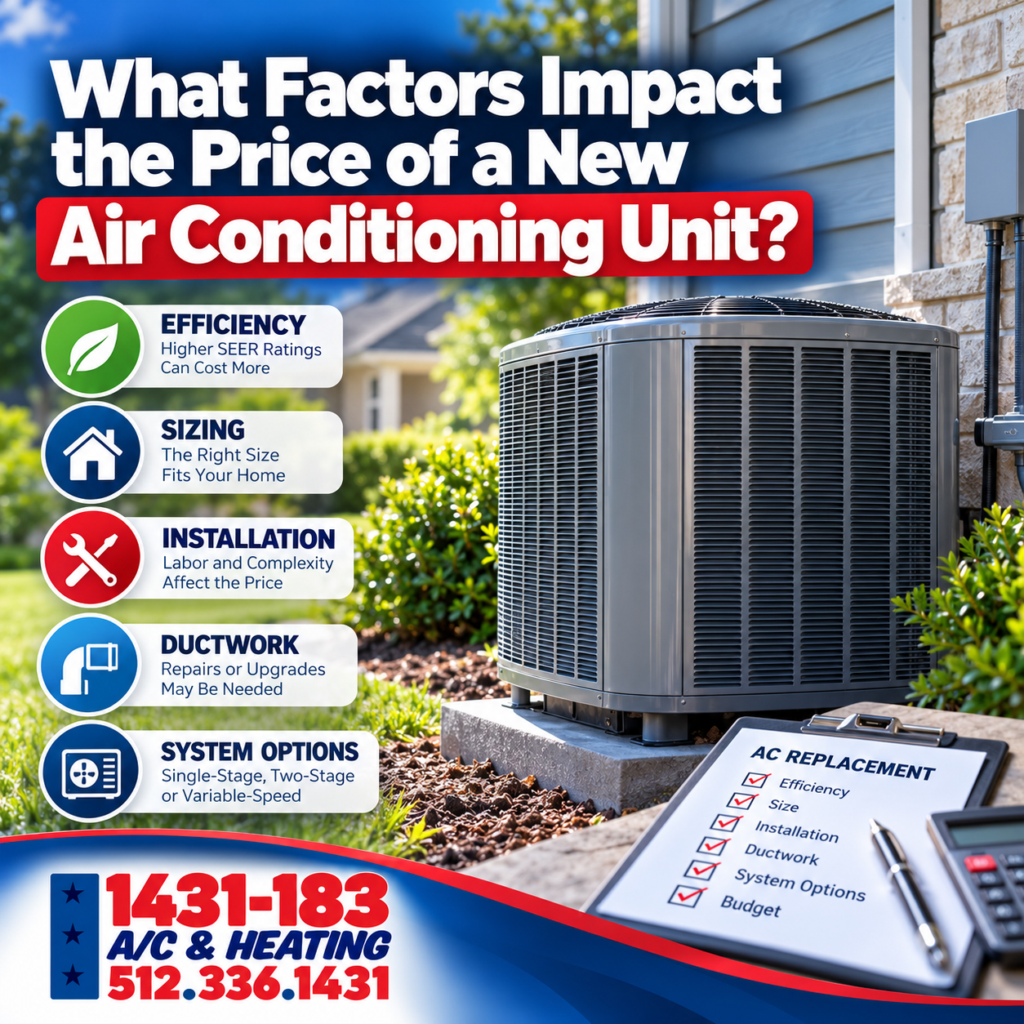
One of the biggest factors affecting the price of a new AC system is its capacity.
Air conditioners are commonly sized in tons, but bigger is not necessarily better.
A system that is too small may run almost constantly while struggling to cool your home. A system that is too large can cool the house too quickly, causing short cycling, uneven temperatures, excess humidity, and unnecessary wear on the equipment.
The right size depends on factors such as:
- The square footage of your home
- Ceiling height
- Number and type of windows
- Insulation levels
- Sun exposure
- Home orientation
- Air leakage
- Number of occupants
A professional HVAC contractor should evaluate the home’s cooling requirements rather than simply replacing the old system with another unit of the same size.
Larger-capacity equipment generally costs more, so proper sizing can have a significant effect on your replacement estimate.
The Efficiency Rating of the New System
Air conditioning systems are available at different efficiency levels.
More efficient systems generally cost more upfront because they use more advanced compressors, motors, controls, and other components. However, they may consume less electricity during operation.
That can be particularly important in Central Texas, where an air conditioner may run heavily for much of the year.
The best choice is not necessarily the system with the highest efficiency rating available. You should consider how long you expect to remain in your home, your typical cooling habits, your energy costs, and your budget.
A reputable HVAC company should be able to explain the differences between available efficiency levels without automatically pushing you toward the most expensive option.
Single-Stage, Two-Stage, and Variable-Speed Equipment
The way an air conditioning system operates can also affect its price.
A traditional single-stage air conditioner essentially operates at full capacity whenever it turns on.
Two-stage systems can typically operate at a lower output during moderate conditions and use their higher capacity when additional cooling is needed.
Variable-capacity systems can make smaller adjustments to cooling output as conditions change.
These more advanced systems can offer advantages such as improved temperature consistency, quieter operation, better humidity control, and potentially greater efficiency.
They also typically cost more than basic single-stage equipment.
The right choice depends on which comfort features matter to you and whether those benefits justify the additional investment.
The Indoor and Outdoor Equipment
When homeowners talk about replacing an “AC unit,” they are often thinking about the outdoor condenser.
However, your air conditioning system has important indoor components as well.
Depending on your existing system and the equipment being installed, replacement may involve:
- The outdoor condenser
- The indoor evaporator coil
- The furnace or air handler
- Refrigerant lines
- Thermostats and controls
- Drain lines and safety switches
HVAC equipment is designed to work as a matched system. Installing components that are properly matched helps the equipment operate as intended and achieve its rated efficiency.
The amount of equipment being replaced will have a major impact on the total project price.
The Type of Heating System You Have
Your heating equipment can also affect an air conditioning replacement.
Some Central Texas homes have traditional gas furnaces paired with central air conditioning. Others use electric heat pumps or different types of air handlers.
If your heating equipment is older, incompatible with the new air conditioner, or nearing the end of its expected service life, it may make sense to discuss replacing additional components at the same time.
This increases the initial project cost, but it may prevent you from paying for another major installation shortly afterward.
Heat Pump vs. Traditional Air Conditioning
Another factor is whether you’re installing a conventional central air conditioner or a heat pump.
A traditional central AC system provides cooling and generally works with a separate heating system.
A heat pump can provide both cooling and heating by transferring heat rather than generating all of its heat directly.
Equipment costs, efficiency ratings, electrical requirements, controls, and installation requirements may differ between these systems.
Your HVAC contractor can help determine which configuration makes the most sense for your home.
The Condition of Your Ductwork
Even a great air conditioner cannot perform properly if the duct system distributing the conditioned air has problems.
Older ductwork may have:
- Leaks
- Poor insulation
- Damaged sections
- Improper sizing
- Restricted airflow
- Disconnected ducts
- Inadequate return air
Sometimes an AC replacement can use the existing ductwork with little or no modification.
In other situations, repairs or improvements may be necessary to make sure the new equipment receives proper airflow.
Significant ductwork modifications can increase the overall project price, but ignoring duct problems can reduce comfort and prevent your new system from performing as expected.
Installation Difficulty
Two homes receiving the same model of air conditioner can still have very different installation costs.
One system may be easily accessible in a garage or utility closet. Another may be installed in a tight attic that is difficult for technicians to reach.
Installation costs can be affected by:
- Attic access
- Equipment location
- Stairs
- Tight working areas
- Required platform modifications
- Electrical upgrades
- Drainage changes
- Refrigerant line modifications
- Local code requirements
More complex installations require more labor and sometimes additional materials.
Electrical Requirements
New HVAC equipment must have the proper electrical service and protection.
Depending on your existing system and the requirements of the new equipment, an installation could require changes to electrical wiring, breakers, disconnects, or other components.
These changes may add to the replacement price but are important for safe and reliable operation.
Refrigerant Line Requirements
The copper refrigerant lines connecting the indoor and outdoor equipment are another consideration.
Sometimes the existing line set can be reused if it is in good condition, properly sized, and compatible with the new system.
In other cases, replacement or modification may be recommended.
The length and accessibility of the refrigerant lines can influence both material and labor costs.
Thermostats and Controls
Modern HVAC systems may require specific thermostats or communicating controls to access all of their features.
A basic system may work with a relatively simple thermostat.
More advanced variable-capacity equipment may use proprietary or communicating controls that allow the indoor and outdoor components to work together more precisely.
Smart thermostats, zoning systems, remote sensors, and other comfort controls can also affect the overall cost.
Indoor Air Quality Upgrades
Replacing an air conditioning system can also be an opportunity to consider optional indoor air quality improvements.
These might include:
- Higher-efficiency filtration
- Media air cleaners
- Whole-home dehumidification
- UV air treatment
- Improved ventilation
These products are not required for every AC installation, but homeowners sometimes choose to add them while other HVAC work is already underway.
Any optional upgrades should be clearly identified on the estimate so you understand what is included in the price.
Permits and Code Requirements
HVAC installations must comply with applicable building, mechanical, and electrical codes.
Depending on where you live, permits or inspections may be required.
Code changes may also mean that something that was acceptable when your original system was installed now needs to be updated during replacement.
A professional HVAC company should account for these requirements when preparing your estimate.
Equipment Brand and Product Line
Equipment manufacturers usually offer several product lines ranging from basic models to premium equipment.
Prices may vary based on:
- Efficiency
- Compressor technology
- Sound levels
- Warranty coverage
- Controls
- Construction
- Additional comfort features
Instead of focusing entirely on the brand name printed on the equipment, consider the complete system, warranty, installation quality, and the company that will be servicing it.
Warranty Coverage
Warranty coverage can vary significantly between systems.
Some equipment may include different lengths of coverage for parts, compressors, heat exchangers, or other major components.
There may also be registration requirements or optional labor warranties.
When comparing estimates, make sure you’re comparing warranty coverage along with the equipment price.
A lower-priced system may not necessarily represent a better value if another option includes substantially better protection.
Installation Quality Matters Just as Much as Equipment
It can be tempting to shop for an air conditioning system based entirely on the equipment model and price.
But HVAC equipment doesn’t install itself.
Proper installation affects efficiency, reliability, comfort, and equipment life.
An HVAC contractor should pay attention to things such as:
- Proper system sizing
- Airflow
- Refrigerant charging
- Electrical connections
- Drainage
- Equipment leveling
- Duct connections
- System commissioning
Even excellent equipment can perform poorly when it is incorrectly installed.
That is why choosing the company installing and maintaining the system can be just as important as choosing the equipment.
Why Two AC Replacement Estimates May Be Very Different
If you receive several estimates, don’t be surprised if the prices aren’t identical.
One contractor may be proposing basic single-stage equipment while another is quoting a higher-efficiency variable-capacity system.
One estimate may include duct modifications, electrical work, a new thermostat, permits, and additional warranties while another does not.
Before comparing the bottom-line prices, make sure you understand exactly what each company is proposing.
Ask what equipment is included, what work will be performed, what warranties apply, and whether there could be additional charges after installation begins.
Comparing the scope of work is much more useful than simply comparing the final numbers.
Get the Right Air Conditioning System for Your Home
Replacing your air conditioner is a major home investment, and you should understand what you’re buying before making a decision.
The goal shouldn’t simply be finding the cheapest AC unit available. It should be finding a properly sized system that fits your home, comfort expectations, energy goals, and budget.
At 1431 AC & Heating, we help homeowners throughout Round Rock and Central Texas understand their options before replacing an air conditioning system.
We’ll evaluate your current equipment, discuss your concerns, explain the available choices, and help you determine which solution makes sense for your home.
If your current AC system is struggling or you’re considering replacement, call 1431 AC & Heating at (512) 336-1431 to schedule an evaluation.
