
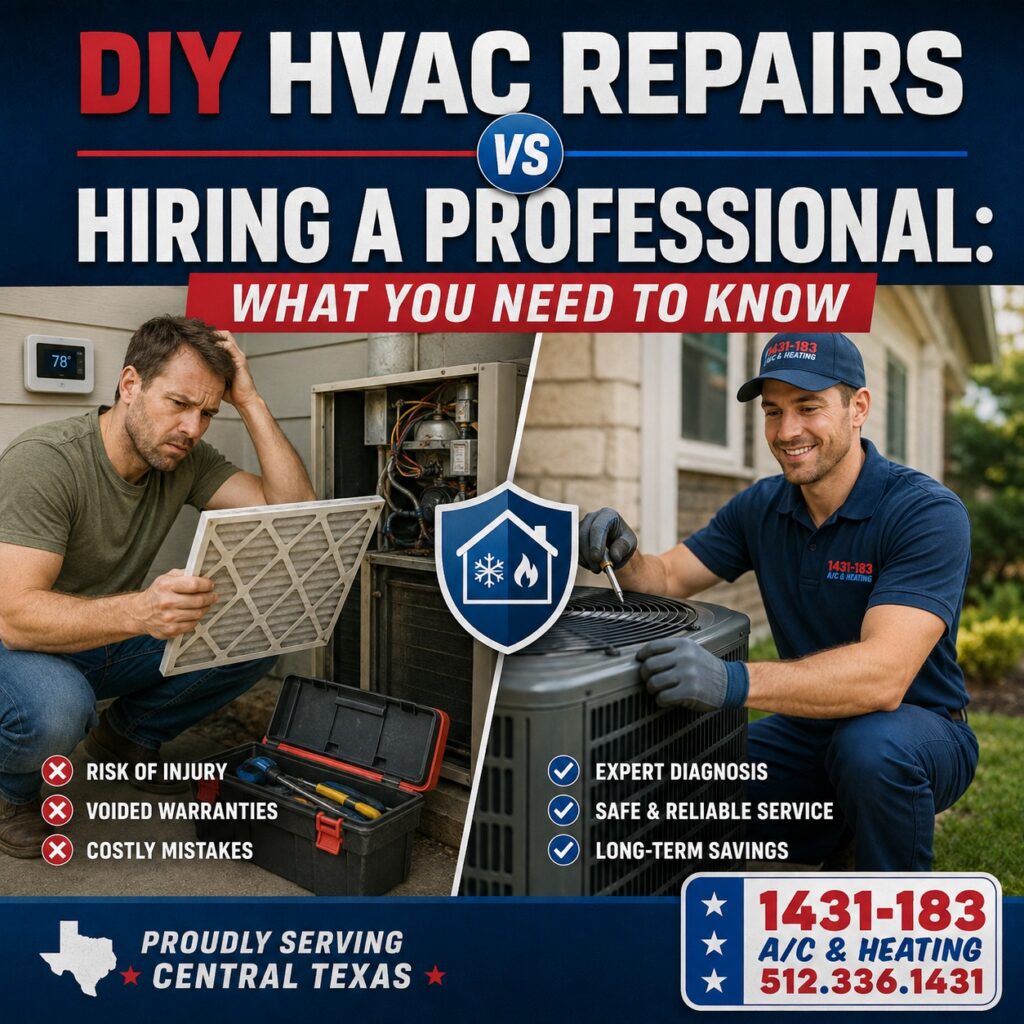
When your air conditioner stops cooling on a hot Central Texas afternoon, it can be tempting to grab a toolbox, watch a few videos, and try to fix the problem yourself. Some basic air conditioning and heating tasks are perfectly reasonable for homeowners to handle. Others involve electricity, refrigerant, expensive components, and safety risks that are better left to a trained professional.
Knowing the difference can save you time, prevent a small problem from becoming an expensive repair, and help get your home comfortable again faster. Here is what homeowners should know before deciding between a DIY repair and calling an air conditioning professional.
Which Air Conditioning Repairs Can You Safely Do Yourself?
Not every air conditioning problem requires a service call. There are several basic things homeowners can check before calling for professional help.
Check and Replace the Air Filter
A dirty air filter is one of the easiest problems to fix.
Your system needs a steady flow of air to work properly. When the filter becomes packed with dust, pet hair, and other debris, airflow can drop significantly.
That can cause problems such as:
- Weak airflow from the vents
- Longer cooling cycles
- Higher electric bills
- Uneven temperatures
- Reduced cooling performance
- Extra strain on the equipment
Check your filter and replace it if it looks dirty. Depending on your home, pets, filter type, and system use, you may need to replace it every one to three months.
During a Central Texas summer, your air conditioner may run for hours every day, so checking the filter regularly is especially important.
Check Your Thermostat Before Calling for A/C Repair
Sometimes what looks like an air conditioning failure is actually a thermostat problem.
Make sure your thermostat is:
- Set to “Cool”
- Set below the current indoor temperature
- Powered on
- Using fresh batteries, if applicable
- Not accidentally programmed for a higher temperature
You can also make sure the fan setting is on “Auto” rather than “On” unless you intentionally want the fan running continuously.
If someone recently adjusted the thermostat or a power interruption changed its settings, this simple check could solve the problem.
Check the Circuit Breaker
If your air conditioner suddenly stops operating, check your home’s electrical panel to see whether a breaker has tripped.
You can reset a tripped breaker once.
If it trips again, stop resetting it and call a professional.
Repeatedly tripping a breaker may indicate an electrical problem with the system. Continuing to reset it without correcting the underlying problem could create a safety risk or damage equipment.
Never remove electrical panels or attempt to repair wiring unless you are properly trained and qualified to do so.
Keep the Outdoor Unit Clear
Your outdoor air conditioning unit needs room to move air.
Leaves, weeds, grass clippings, and other debris can collect around the equipment and interfere with airflow.
Homeowners can safely keep the surrounding area clear. Trim vegetation away from the unit and remove loose debris from around it.
Be careful when doing yard work near your air conditioner. String trimmers, lawn equipment, and landscaping tools can damage wiring, refrigerant lines, or the thin metal fins surrounding the unit.
When Should You Hire a Professional for Air Conditioning Repairs?
Once troubleshooting goes beyond basic maintenance and simple checks, calling a trained technician is usually the safer choice.
Modern air conditioning systems contain electrical components, motors, controls, refrigerant, sensors, and other parts that require specialized tools and training.
Guessing at the problem can make an inexpensive repair much more expensive.
Refrigerant Problems Should Be Left to a Professional
If your air conditioner is low on refrigerant, adding more is not the same as filling your car with gasoline.
Air conditioning systems are designed as closed systems. Under normal conditions, refrigerant does not simply get “used up.”
Low refrigerant can indicate a leak.
Possible signs include:
- Air that is not getting cold
- Longer cooling cycles
- Ice forming on the system
- Unusual hissing sounds
- Higher energy bills
- Difficulty keeping the house comfortable
A professional technician can determine whether the refrigerant level is actually the problem, look for leaks, repair the cause when appropriate, and properly service the system.
Trying to handle refrigerant yourself can be dangerous and may result in an incorrect diagnosis.
Electrical A/C Repairs Are Not Good DIY Projects
Air conditioners use powerful electrical components.
Parts such as capacitors, contactors, motors, wiring, and control boards can fail over time. Diagnosing and replacing these components should generally be handled by a trained technician.
Even after equipment has been turned off, certain components can retain an electrical charge.
If your air conditioner:
- Hums but does not start
- Repeatedly trips the breaker
- Has a burning smell
- Makes electrical buzzing noises
- Turns on and off unexpectedly
Turn the system off and call for professional service.
A burning smell, smoke, sparking, or other signs of an electrical problem should be treated seriously.
Frozen Air Conditioning Systems Need More Than Ice Removal
Seeing ice on your air conditioner may seem strange when it is 100 degrees outside, but frozen systems are fairly common.
Ice can form because of problems such as:
- Restricted airflow
- A dirty air filter
- A dirty indoor coil
- Refrigerant problems
- Blower motor problems
- Other mechanical issues
Simply removing or melting the ice does not necessarily address the cause.
If you notice ice, turn off the cooling system and check the air filter. If the system freezes again or you cannot identify an obvious cause, schedule professional service.
Continuing to operate a frozen system can potentially cause additional damage.
DIY Repairs Can Make a Small Problem More Expensive
One of the biggest risks with DIY air conditioning repairs is not the cost of the part. It is the cost of fixing what happens after the wrong repair.
Imagine your air conditioner stops working in Round Rock.
You search online and decide the capacitor is bad. You purchase a replacement and install it, but the capacitor was not actually the problem.
Now the original problem still exists, and you may have introduced another one.
A trained technician does more than replace parts. The technician diagnoses the entire system to determine what caused the failure.
That distinction matters.
Replacing a failed part without understanding why it failed can lead to another breakdown shortly afterward.
Online Videos Cannot Diagnose Your Specific System
Online tutorials can be helpful for learning how air conditioning systems work, but they cannot see what is happening inside your home.
Two air conditioners can show the exact same symptom for completely different reasons.
For example, an air conditioner blowing warm air could be caused by:
- A thermostat setting
- A tripped breaker
- Restricted airflow
- An outdoor unit problem
- An electrical component failure
- A refrigerant problem
- A compressor problem
The symptom tells you something is wrong. It does not always tell you what needs to be replaced.
Professional diagnosis helps prevent unnecessary repairs and wasted money.
What About the Cost of Hiring an A/C Professional?
Cost is one of the biggest reasons homeowners consider DIY repairs.
That makes sense. Nobody wants an unexpected repair bill. But the cheapest repair is usually the one that correctly fixes the problem the first time.
A DIY repair may seem less expensive if you are comparing the cost of a part to the cost of a service visit. That comparison leaves out something important: diagnosis.
You need to know which part failed, why it failed, and whether another issue caused the failure.
At 1431-183 A/C & Heating, we believe homeowners should understand what is wrong before making a decision. Clear explanations and upfront pricing can help you decide what makes the most sense for your home and budget without unnecessary upselling.
DIY A/C Repair vs Professional Repair: How Do You Decide?
A simple rule can help.
If the task involves routine homeowner maintenance, it may be reasonable to handle it yourself.
If it involves diagnosing, opening, repairing, or replacing internal electrical or mechanical components, call a professional.
DIY Tasks That May Be Reasonable
Homeowners can generally handle basic tasks such as:
- Replacing the air filter
- Checking thermostat settings
- Replacing thermostat batteries
- Checking for a tripped breaker
- Keeping vegetation away from the outdoor unit
- Looking for obvious airflow problems
Tasks Better Left to a Professional
Call an experienced technician for problems involving:
- Refrigerant
- Electrical components
- Capacitors
- Motors
- Compressors
- Internal wiring
- Frozen systems that keep freezing
- Repeatedly tripping breakers
- Unusual noises or odors
- System diagnosis
- Major component replacement
When you are uncertain, calling for professional advice is usually safer than experimenting with expensive equipment.
When an A/C Problem Becomes an Emergency
An air conditioning problem becomes much more urgent during a Central Texas summer.
Indoor temperatures can rise quickly when the system stops working, especially during extreme heat.
You should also stop operating the equipment and seek professional help if you notice:
- Smoke
- Sparks
- Burning odors
- Repeated electrical problems
- Loud grinding or banging sounds
- Water leaking near electrical components
Households with young children, older adults, pets, or anyone who may be particularly vulnerable to extreme heat should take a cooling failure seriously.
1431-183 A/C & Heating offers emergency service when homeowners need help getting their comfort back quickly.
A Professional Repair Can Give You More Than a Working Air Conditioner
The goal shouldn’t be simply getting the system to turn back on.
You want to know that the actual problem has been found and properly repaired.
An experienced technician can inspect the system, identify the cause of the failure, explain the options, and help you understand whether repair or replacement makes sense.
1431-183 A/C & Heating has more than 20 years of experience helping homeowners with air conditioning and heating problems throughout Central Texas.
We serve homeowners in Round Rock, Georgetown, Cedar Park, Leander, Liberty Hill, North Austin, and surrounding communities.
Our goal is simple: show up when you need us, explain the problem clearly, provide upfront pricing, and fix it the right way.
Frequently Asked Questions About DIY AC Repairs
Can I repair my air conditioner myself?
Homeowners can usually perform basic maintenance and troubleshooting, such as changing filters, checking thermostat settings, and keeping the outdoor unit clear. Repairs involving electrical components, refrigerant, motors, compressors, or internal system components should generally be handled by a trained professional.
Should I reset my air conditioning breaker if it trips?
You can reset a tripped breaker once. If it trips again, do not continue resetting it. Repeated trips could indicate an electrical or mechanical problem that needs professional diagnosis.
When should I call an AC repair company?
Call a professional when basic troubleshooting does not solve the problem, the air conditioner continues blowing warm air, the breaker repeatedly trips, the system freezes, you hear unusual noises, or you notice burning smells or electrical problems.
Don’t Turn a Simple AC Repair Into a Bigger Problem
There is nothing wrong with taking care of the simple things yourself. Changing your filter, checking the thermostat, and keeping your outdoor unit clear can help your air conditioning system work properly and may even prevent unnecessary service calls.
But there is also a point where DIY troubleshooting should stop.
When your air conditioning problem involves electricity, refrigerant, internal components, repeated failures, or a problem you simply cannot identify, professional diagnosis can save you from wasted time and costly mistakes.
1431-183 A/C & Heating provides fast, dependable air conditioning and heating service throughout Williamson County and surrounding Central Texas communities. With upfront pricing, honest recommendations, emergency service, and more than 20 years of experience, we are here to help you get your home comfortable again.
Don’t spend another hot afternoon guessing what is wrong with your air conditioner. Call 1431-183 A/C & Heating now.
